Geeks in Phoenix

Geek Blog


Things to consider when choosing an air or liquid CPU cooler

As technology advances, effective CPU cooling solutions have become essential. High-performance processors generate significant heat, which can hinder performance and cause damage if not managed properly. Among the top cooling options, air and liquid cooling systems are favored by gamers and professionals.

Things to consider when choosing an air or liquid CPU cooler

Air cooling employs heat sinks and fans to dissipate heat, making it an affordable and straightforward choice for many users. Quality air coolers use large heatsinks and powerful fans for effective heat dissipation, are known for their reliability, and are easy to install.

In contrast, liquid cooling excels in thermal conductivity, using a closed-loop system with tubes, a liquid block, and a radiator to achieve lower temperatures. This method benefits overclockers and high-performance setups, though it is more complex to install and typically pricier.

This article will explore the pros and cons of both cooling systems, helping you make an informed decision based on your specific CPU cooling needs.

Air Cooling

Examples of CPU air coolers

Air cooling uses heatsinks and fans to dissipate heat generated by the CPU. A heatsink is typically made of aluminum or copper and is designed to absorb heat from the processor. Attached to the heatsink are one or more fans that increase airflow, enhancing cooling.

Pros of air cooling

  • Simplicity and accessibility: One of the most significant advantages of air cooling is its relative simplicity. Installing an air cooler usually involves just mounting the heatsink onto the CPU and plugging in the fan. This makes it a suitable option even for those new to PC building.
  • Lower cost: Air cooling systems are generally less expensive than their liquid cooling counterparts. For budget-conscious users, air coolers can provide adequate cooling without breaking the bank. There are numerous air cooling options available at varying price points, offering flexibility based on budget and performance needs.
  • Reliability: Air coolers have fewer failure points than liquid cooling systems, as they do not involve pumps, reservoirs, or coolant. This enhances reliability; if an air cooler fails, it typically just results in higher temperatures, whereas a liquid cooling failure can lead to leaks and potential component damage.
  • No maintenance required: With air cooling, maintenance is minimal. Users may occasionally need to clean dust from fans and heatsinks. Overall, air coolers require far less attention than liquid cooling systems, which may require periodic checks of liquid levels and for potential leaks.

Cons of air cooling

  • Efficiency limitations: While air coolers can adequately cool most CPUs, they can struggle under heavy loads, especially when overclocking. The efficiency of air cooling is lower than that of liquid cooling at extreme performance levels.
  • Size and compatibility issues: High-performance air coolers can be bulky, leading to compatibility issues with certain cases and motherboards. Large heatsinks may obstruct RAM slots or interfere with other components, which can be a concern for compact builds.
  • Noise levels: Although many modern air coolers are engineered to be quiet, they can still produce noise, especially under high-load conditions. Fans spinning quickly to maximize cooling can create a noticeable sound, which might be a consideration for users seeking a silent build.

Liquid cooling

Examples of CPU liquid coolers

Liquid cooling uses a coolant to absorb heat from the CPU and transfer it away via a series of tubes, often with a radiator and fans to dissipate it into the environment. There are two main types of liquid cooling: All-in-One (AIO) and custom loops. AIOs are sealed and are not serviceable. Custom loops are open and completely serviceable.

Pros of liquid cooling

  • Superior cooling performance: Liquid cooling systems can dissipate heat more efficiently than air cooling solutions, especially under heavy loads or during overclocking. This makes liquid cooling an attractive option for high-performance builds and gaming rigs.
  • Lower noise levels: Liquid cooling systems can operate more quietly than air coolers, particularly with larger radiators and slower-turning fans. The ability to manage temperatures without high RPMs contributes to a quieter overall system.
  • Aesthetics and customization options: For many enthusiasts, the visual appeal of a liquid cooled system is a significant advantage. Custom loops offer opportunities for unique reservoir designs, tubing arrangements, and RGB lighting that can enhance the look of a PC build.
  • Space efficiency: Liquid cooling enables more flexible component placement. Moving heat away from the CPU to a radiator located elsewhere in the case can free up space around the processor, potentially improving airflow and overall cooling.

Cons of liquid cooling

  • Complexity and installation difficulty: Liquid cooling systems, especially custom loops, can be complex to install and require careful planning and expertise. For those without PC-building experience, this complexity may pose a barrier.
  • Higher cost: Liquid cooling setups are generally more expensive than traditional air coolers due to additional components, such as pumps, radiators, and tubing. This cost can be prohibitive for those on a budget.
  • Maintenance requirements: Liquid cooling systems require regular maintenance to ensure optimal performance. Most liquid users need to monitor coolant levels, check for leaks, and potentially replace the coolant every few years. This added maintenance can be a hassle for some.
  • Risk of leaks: The most significant drawback of liquid cooling is the risk of leaks, which can cause catastrophic damage to components. While modern systems are designed to minimize this risk, it is still a concern for many users.

In summary, both air and liquid cooling solutions have distinct advantages and disadvantages. Air cooling is known for its simplicity, cost-effectiveness, and reliability, while liquid cooling offers superior cooling performance and improved aesthetics. The choice between the two ultimately depends on your specific needs, budget, and the level of maintenance you are willing to perform. By considering these factors, you can make an informed decision to help keep your CPU running efficiently and reliably.

Tips for choosing the right CPU cooler for your custom-built computer

Are you looking for ways to keep your computer running smoothly and prevent overheating? The CPU (Central Processing Unit) cooler is a critical component that plays a significant role in keeping your computer cool. Choosing the right cooler that meets your needs and keeps your system from overheating is essential. In this article, we'll explore some tips for selecting the right CPU cooler for your custom-built computer.
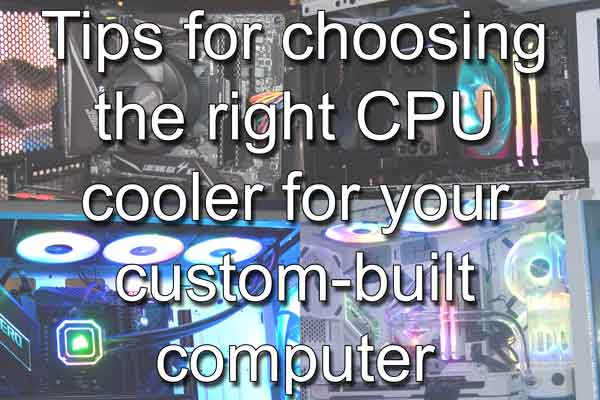
Tips for choosing the right CPU cooler for your custom-built computer

Shopping for a CPU cooler can be a daunting task due to the overwhelming number of options available. To choose the right CPU cooler, you will need to take into consideration the type of CPU, available space, noise level, and whether you prefer an air or liquid cooler. Aesthetics may also play a role in your decision. Let's look at some of the things you must consider when choosing the right CPU cooler.

Compatibility and size: The first thing to consider in choosing the right CPU cooler for your custom-built computer is compatibility. Most CPU coolers will fit the majority of motherboards on the market, but if the CPU is relatively new, the coolers that support it may be limited.

The second thing you need to consider is the size of the CPU cooler. With CPU coolers, you must look at the space required for the heatsink (air) or radiator (liquid). For air coolers, is there enough room between the CPU on the motherboard and the side panel on the case? For liquid coolers, is there enough room in the case for a radiator and fan assembly?

Air or liquid: When it comes to CPU cooling, there are two (2) primary options: air or liquid cooling. Air coolers use fans to circulate air over a heatsink, while liquid coolers use a closed-loop system to circulate coolant over the CPU and through the radiator. While both options can provide excellent cooling performance, liquid cooling is typically more efficient and quieter than air cooling.
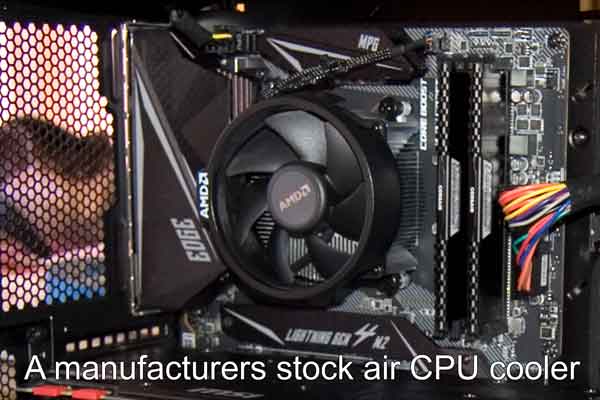
A manufacturers stock air CPU cooler

Now, some CPUs will come with a standard air cooler included. These work perfectly fine for surfing the web or checking email, but if you plan on putting the CPU under a heavy load, an air cooler with a larger heatsink or liquid cooler might be the best bet.
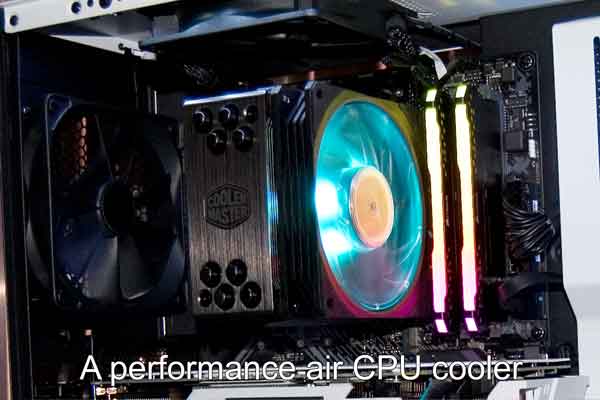
A performance air CPU cooler

Many years ago, Intel used to have different warranty periods for CPUs that came with and without their cooler (3 years with / 1 year without), so checking the warranty coverage is recommended. Also, remember that liquid cooling can be more expensive and challenging to install, so it's essential to weigh the pros and cons before making a decision.

With liquid cooling, there are two (2) types of systems: All-In-One (AIO) or a custom loop. AIOs are sealed and are not serviceable.
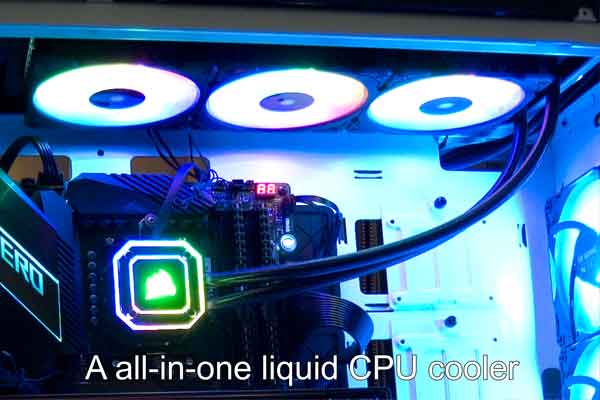
A all-in-one liquid CPU cooler
Custom loops are open and can be serviced.
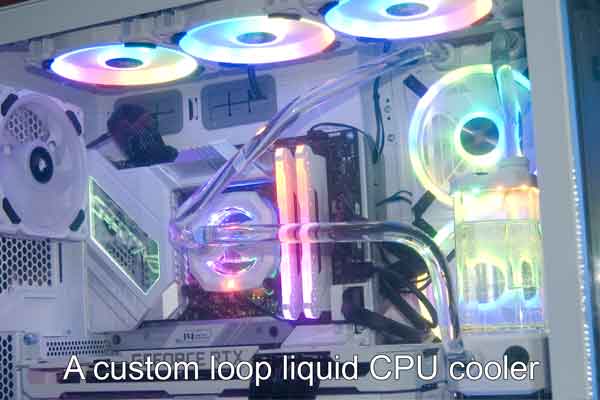
A custom loop liquid CPU cooler
AIOs are easier to install but can not have any of the parts repaired or coolant replaced. Custom loops can be repaired, and coolant can be replaced, but use hard acrylic lines that must be cut and bent to the specific application.

Noise levels: The noise level is another critical factor to consider when choosing a CPU cooler. Some coolers can be loud, especially if you over-clock your CPU, which can be distracting and annoying when trying to work or play games. If you're looking for a quieter option, consider a liquid cooler or a low-noise air cooler. Be sure to check the specifications and reviews to get an idea of how loud a particular cooler is before making a purchase.

Remember that an air cooler with a large heatsink and multiple fans or a liquid cooler with a large radiator and multiple fans will cool much better than the manufacturer cooler. But with more fans comes more noise, so check the specifications of any cooler you are looking to purchase.

Cooling performance: One of the most important factors to consider when choosing a CPU cooler is the cooling performance. The cooler's ability to dissipate heat from the CPU significantly affects the overall system temperature. A high-performance cooler will keep your CPU running at optimal temperatures, which can improve system stability and prevent damage to your components.

Be sure to look for coolers with a high thermal efficiency rating and a high airflow rate for maximum cooling performance. Remember that with a large surface area, like with a large heatsink or radiator, you will get better cooling performance. And with plenty of airflow, your CPU will keep its cool even when throttled to the max.

Your budget: Finally, it's essential to consider your budget when choosing a CPU cooler. CPU coolers can range in price from as little as $20 to as much as $200 or more. While more expensive coolers may provide better cooling performance, they may not be necessary for your system. Be sure to weigh the features and benefits of each cooler against its price to find the best option for your needs and budget.

In conclusion, choosing the right CPU cooler for your computer is critical to keeping your system running smoothly and preventing overheating. By considering factors such as compatibility and size, air or liquid cooling, noise levels, cooling performance, and budget, you can find the perfect cooler to meet your needs and keep your computer cool. Be sure to do your research, read reviews, and compare options to make an informed decision and keep your computer running at its best.

Free computer diagnostics

Repairing a PC can sometimes be expensive, and that is why we offer free basic in-shop diagnostics. Give one of our professional and experienced technicians a call at (602) 795-1111, and let's see what we can do for you.

Check out our reviews

Geeks In Phoenix LLC, BBB Business Review

This business is BBB Accredited

Customer service is #1

Here at Geeks in Phoenix, we take pride in providing excellent customer service. We aim to give the highest quality of service  from computer repair, virus removal, and data recovery.

Bring your computer to us and save

Repairing a computer can be time-consuming. That is why we base our in-shop service on the time we work on your computer, not the time it takes for your computer to work! From running memory-checking software to scanning for viruses, these are processes that can take some time.

Contact us

If you have any questions, please feel free to give us a call at (602) 795-1111  and talk with one of our Geeks. Or you can send us a message from our contact page , and one of our Geeks will get back to you as soon as possible. Or you can stop by and see us. Here are our hours and location.

Like Geeks in Phoenix on Facebook

Follow Geeks in Phoenix on Twitter

Watch Geeks in Phoenix on YouTube